FinanceHigh
Why paying a Chinese supplier costs Nigeria twice, and what Cardoso wants to change
Cardoso takes Nigeria's cross-border payment talks to Beijing. Why paying Chinese suppliers still runs through dollars, and what a direct channel would change.
By Betini Udom Published 3 min read Editorial Policy Report a correction
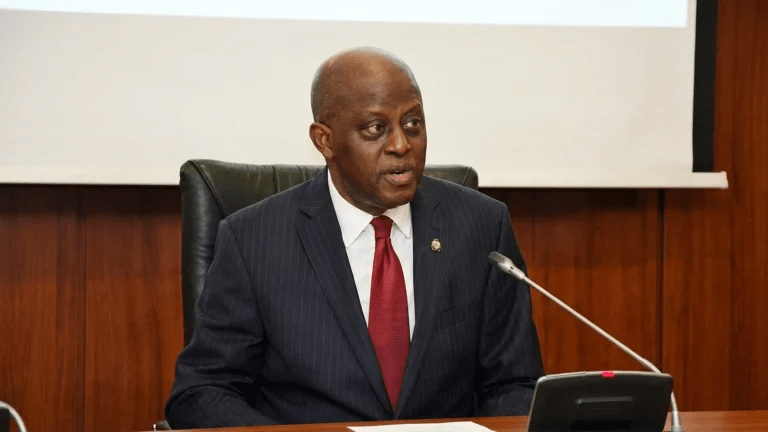
Olayemi Cardoso, governor of the Central Bank of Nigeria, says Nigeria will push for stronger cross-border payment arrangements with China, and that he will take the discussion to Beijing. He said it at a briefing after Nigeria's delegation attended this year's IMF and World Bank Annual Meetings in Bangkok, where he had met Pan Gongsheng, who runs China's central bank.
The topics he listed were cross-border payments, settlement arrangements, financial technology and trade finance.
What is actually broken?
Think about a trader in Lagos buying generators from a factory in Guangzhou.
She earns naira. The factory wants yuan. With no direct road between them, the payment detours: naira into dollars, dollars into yuan, through correspondent banks abroad. Two conversions, two sets of charges, two exchange-rate spreads, and a wait.
Worse than the fees is the dollar itself. She must source dollars before she can pay at all, so when they are scarce or expensive her order stalls — not for want of money, but for want of the right money.
That is the thing Cardoso is describing when he says "cross-border payments". Not a new product. A shorter road.
How much trade are we talking about?
Enough that the plumbing matters.
Nigeria-China trade reached about $18 billion in the first half of 2026, according to figures given by Power Minister Joseph Tegbe. That is roughly 64% of the $28 billion recorded across the whole of 2025, reached in half the time. (Derived.) The Chinese ambassador to Nigeria put total trade growth at 35% and the growth in Nigerian exports to China at 80%.
So this is not a small trade relationship with an inconvenient payment problem. It is one of Nigeria's largest, growing fast, running on a detour.
Doesn't Nigeria already have a deal with China?
It does, and this is where the size problem shows.
Nigeria and China have a currency swap — an arrangement where the two central banks agree to supply each other's currency, so Nigerian businesses can get yuan and Chinese businesses can get naira without going through dollars. It was first signed in 2018 and renewed in December 2024 at 15 billion yuan, about $2 billion, for three years.
Now hold that against the trade. If Nigeria-China trade continues at the first-half 2026 pace, it runs to roughly $36 billion for the year. (Derived.) A $2 billion facility against $36 billion of trade is about $5.60 for every $100 that changes hands. (Derived.)
That is the gap. The swap is a useful tool, not a payment system. What Cardoso appears to be after is something that works at the scale of the actual trade.
What else was he doing in Bangkok?
He met Standard & Poor's and Moody's — the agencies that score how safely a country can be lent to — and argued Nigeria's case for reaching investment grade in the medium term. Keep that in proportion: S&P raised Nigeria to B in May 2026, its first upgrade since 2020, and investment grade starts five notches higher at BBB−. (Derived.) It is an ambition being argued, not a forecast the agencies have issued.
He also pointed to September's rate decision — a cut from 26.5% to 23%, the largest since 2006 — as evidence that Nigerian institutions are predictable.
The delegation went beyond China too, meeting Singapore's central bank and hosting a Nigeria-Asia financial event with JPMorgan, the Nigerian Exchange Group and FMG Group.
What to watch
This section is Rainingmoney's reading.
Whether anything is signed. At the moment there is a meeting, a stated intention and a planned visit. No mechanism, no timeline, no agreement.
Which route they choose. A bigger swap line is the easy option. Connecting Nigerian banks directly into China's own payment network would be the substantial one, and Nigerian importers would feel that far more.
Whether costs actually fall. The test is not the announcement in Beijing but whether a Lagos importer's charges and waiting time drop a year later.
The bottom line: Nigeria's trade with China has surged while the financial channel serving it stayed the same size. This is a statement of intent about fixing that, and nothing more yet.
Sources & Verification
- Olayemi Cardoso's briefing after the 2026 IMF and World Bank Annual Meetings in Bangkok.
The Money Print
Market intelligence before the market opens.
Pan-African capital flows and the stories behind the numbers, on weekday mornings.